
Summary
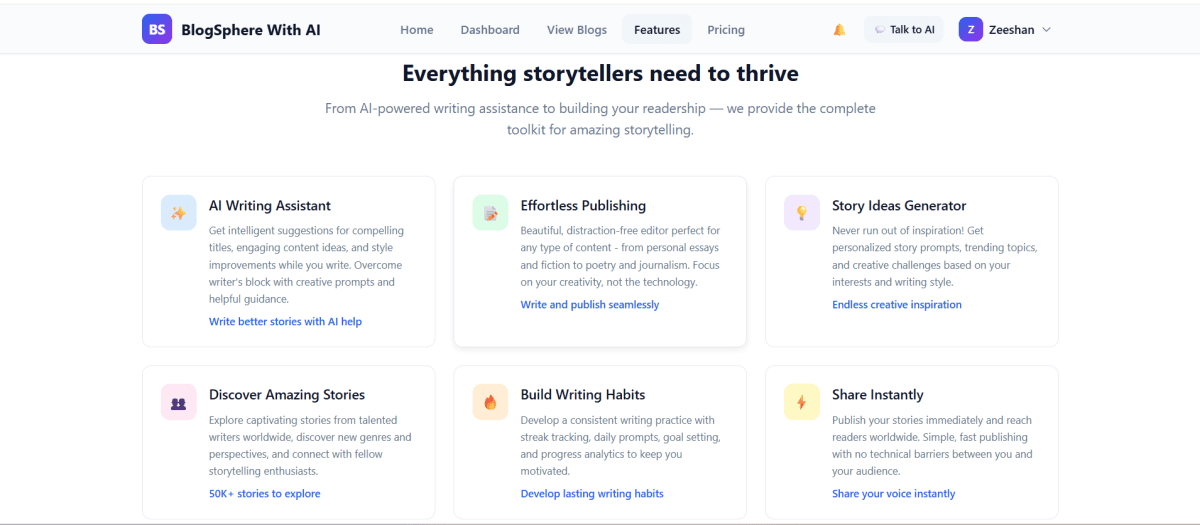
I built BlogSphere, a full-stack content platform that blends a delightful writing experience with real-time community features and AI assistance.
It uses Next.js App Router for performant server-rendered pages, MongoDB for content and engagement data, Pusher for instant feedback loops, Cloudinary for media, and OpenRouter-powered AI endpoints for rewriting, summarizing, and chat.
The system includes moderation tools, an analytics dashboard, billing flows, and SEO surfaces like RSS and sitemaps—shaped to feel like a production-ready product.
My Role
Full-stack developer owning architecture, implementation, and integration
Designed the data models, API surfaces, UI flows, and operational concerns (auth, caching, revalidation, SEO)
Motivation
I wanted a modern, realistic blog platform that moves beyond static publishing — where authors collaborate with AI, audiences engage in real-time, and the system scales with good defaults (auth, caching, revalidation, background updates).
It’s a proving ground for Next.js 14 App Router patterns and event-driven UX.
Tech Stack
Framework: Next.js 14 (App Router, route handlers, SSR)
Auth: NextAuth.js with Credentials, Google, GitHub
Database: MongoDB via Mongoose
Realtime: Pusher (private user channels, post/comment rooms)
Storage/Images: Cloudinary (cover images, avatars, transformations)
AI: OpenRouter (OpenAI-compatible client) for summarize/rewrite/continue and chatbot
Search/Discovery: MongoDB/Atlas Search, custom feed ranking and trending
Cache: Optional Redis helpers with safe fallbacks
Email: Resend + HTML templates for likes, comments, bookmarks, and system emails
Styling: Tailwind CSS (+ typography plugin)
Editor: TipTap (rich text, extensions)
Tooling: ESLint, Prettier, Husky/lint-staged
Deployment: Vercel-ready (standalone output, images remotePatterns)
Architecture
App Router Structure (under src/app)
Includes server components and route handlers under /api:
Auth:
/api/auth/[...nextauth](NextAuth wired to custom auth options)Content:
/api/posts(create/list),/api/comments,/api/reactions,/api/bookmarksDiscovery:
/api/search,/api/trending,/api/feedRealtime:
/api/pusher/auth(notifications broadcast toprivate-user-{providerId})AI:
/api/ai-suggest(summarize/rewrite/continue),/api/chatbot(chat)Moderation:
/api/moderation/(block-user|report|post-status)Profile:
/api/profile(avatar upload via Cloudinary; followers/following; stats; posts)Admin:
/adminpages +/api/admin/audit-logBilling:
/billingpages +/api/billing/(initiate-payment|subscription|cancel)
Data Modeling (Mongoose, src/models)
User: provider + providerId, credentials hash, profile, social graph (follows/followers), bookmarks, email prefs, subscription (plan, status, usage, expiry, PKR pricing flow)
Post: slug, status (draft/published/archived), schedule date, tags/category, author snapshot, reactions, views/reads, SEO fields
Comment: threaded replies, reactions, moderation status
PostVersion: versioned snapshots for history
Read/Audit/Report: analytics and admin oversight objects
Libraries (src/lib)
db: idempotent Mongo connection
auth/authOptions: unified auth across credentials and OAuth, session/JWT callbacks enriching session
cloudinary: streaming uploads with transformations, avatar pipeline
resend + emailTemplates: templated notifications; dev-only restrictions for safe sending
pusherServer/pusherClient: real-time events for likes/comments/notifications/profile-stats
redis: optional cache helpers with no-op fallbacks
contentRules/validation: simple content gating and Zod request validation
search/trending/analytics: custom ranking, trending scores, and dashboards
Middlewares and SEO
middleware.js: gates
/billing,/dashboard, and some API routes under auth cookie checksSEO Routes: robots, sitemap, RSS, and
/feed.xml; dynamic base URL resolution for Vercel/local environments
Key Features
Rich Authoring
TipTap editor with image upload (Cloudinary), markdown rendering, and SEO fields
Version history via PostVersion; scheduling support (
scheduledAt)
AI Assistance
/api/ai-suggestsupports summarize/rewrite/continue modes with OpenRouter models/api/chatbotprovides a general chat endpoint for creative ideation
Real-Time Engagement
Likes, reactions, and comment streams via Pusher
Instant updates to post rooms and private user channels
Event-driven notifications and profile stat updates
Discovery and Analytics
Trending feeds and personalized “For You” feed with scoring function (interactions, age decay, follows, tag affinity)
Read-time tracking with
/api/readsfor dashboard analytics
Social Graph and Bookmarking
Follow authors and bookmark posts
Bookmark-triggered notifications and email digests
Moderation and Admin
Content rules validation for posts/comments
Moderation endpoints for reports and block-user
Admin area (tags, comments, users, reports) and audit logs
Subscriptions and Billing (PKR)
One-time payment flow (EasyPaisa/JazzCash UX)
30-day access windows with plan limits (posts, storage, API calls)
Subscription state stored on User with plan, usage, limits, startDate/expiresAt
Notable Implementation Decisions
App Router with Route Handlers
Consolidates server logic per resource, enables explicit GET/POST/PATCH handlers, and supports streaming uploads via web APIsAuth and Identity Normalization
Unifies credentials and OAuth users by providerId; session/JWT callbacks enrich session with role and providerId while staying in sync with DBSlug and Scheduling Correctness
Unique slug generator with collision checks; consistent published boolean based on status and schedule to prevent premature publishingReal-Time Notifications at Domain Boundaries
private-user-{providerId}channels for direct notifications (likes, bookmarks, comments) and stats updatesSafe, Optional Infrastructure
Redis cache helpers act as no-ops withoutREDIS_URL; Resend emails guarded for dev-safe usage; DB connections idempotentImage Pipeline
Cloudinary streaming uploads with transformations and distinct presets for avatars/covers;remotePatternsconfigured innext.config.jsPerformance and Consistency
.lean()for heavy reads, selectiverevalidatePathcalls, cache busting on create
Backfills author fields in list queries to ensure resilient UI even when snapshots are missing
Challenges I Solved
Multi-Provider Auth Coherence
Reconciled OAuth and credentials identities, keeping sessions and JWTs enriched and consistent over timeRealtime UX Without Over-Coupling
Encapsulated Pusher logic, used stable channel naming, prevented self-notifications, and wired profile-stats updates as separate eventsContent Lifecycle
Resolved complex logic for draft/published/scheduled states to avoid accidental publishing and maintain accurate SEO surfacesReliable Media and Email in Development
Hardened Cloudinary upload streams and added dev-safe Resend behavior to avoid 403s locallyRanking and Discovery
Built a pragmatic scoring function mixing engagement signals, recency, follows, and tag affinity
Impact and Results
Author Experience
Fast editor with AI helpers and clean media pipeline
Predictable publishing with scheduling
Community Feel
Real-time likes, comments, and notifications
Immediate feedback loops that encourage engagement and repeat visits
Operable System
Admin and moderation tools
Analytics, RSS/sitemap/robots for SEO and distribution
Cache and revalidation integration for smooth performance
What I’d Improve Next
Security and Limits:
Add rate limiting per route, stricter input validation everywhere, and more granular role checks on admin endpointsAI and Search:
Expand to semantic/vector search and AI-assisted tagging; migrate to the Vercel AI SDK for streaming UXObservability and Jobs:
Add centralized logging/metrics and background jobs/queues for email and analytics aggregationPayments:
Unify billing with a provider SDK or webhooks; improve subscription expiry automationTesting/QA:
Add unit/integration tests for API routes and E2E flows for editor/publishing/authPerformance:
Pagination on heavy lists, selective field projections, and edge/runtime choices where appropriate
How This Reflects My Approach
I aim for cohesive systems that are delightful to use and robust to operate.
I keep the architecture modular, adopt pragmatic defaults (idempotent DB connects, optional caches, safe email), and lean into event-driven UX where it adds real value.
With BlogSphere, I focused on real features that demonstrate product thinking —
auth, AI, realtime, moderation, analytics, and distribution — woven into a consistent developer experience.